
Creating young musicians since 2012...


What we do...
United Lyra teaches music in a unique way - provides regular performance opportunities - sends them for international music examination conducted by Associated Board of the Royal Schools of Music, London (ABRSM) - creates performers of high calibre in western classical music at a very young age. Our teachers are well-trained to handle young students of 6 - 19 years in a professional way, understanding, interacting and fostering a life-long engagement with music. We teach Piano, Violin, Cello, Guitar, Saxophone, Clarinet, Flute, Trumpet, Trombone and many other music instruments. Our music lessons are designed to lay a solid foundation in western classical music in a progressive way, providing regular performance opportunities, guest performances, and international certification. We do focus more on acoustic music in order to master the nuances of western classical music.
We strive to develop a community of musicians who learn music in a group setting, interact socially and musically with each other, enjoy performing, set and work additional goals to get international certifications from Associated Board of the Royal Schools of Music, London, world's leading provider of music examinations [ABRSM].
Our history...
In 2012, United Lyra Music School was started in Egatoor, near Siruseri IT Park, just opposite to Hiranandani Upscale, by William Kumar, who quit his job as Band Director at American International School, Taramani, to promote western classical music to the community in Chennai. It was the first music school in the OMR area teaching western classical music with a well founded curriculum for piano, violin, classical guitar, singing and voice training, trumpet, trombone, cello, flute, clarinet and many other instruments. The music school from the very beginning is affiliated to the Associated Board of the Royal Schools of Music, London (ABRSM). United Lyra Music School is the Regional Office of ABRSM, London for Tamilnadu & Pondicherry region since 2015. The students of United Lyra were the first ones to take ABRSM practical and theory exams in the South Chennai area. With regular concerts, international certifications from ABRSM, music practical & theory lessons, progressive method books, and many other activities, United Lyra set an example for a music school in Chennai. We have created many highly successful and talented young musicians, and a few of our students have chosen music as career and joined music conservatories abroad. From the very beginning we specialize in teaching young children from the age of 5, so our students reach the highest level of music before they go to college.
Today, we are a well known music school on the OMR offering online / offline music lessons for various music instruments. Every moment of our journey during the last decade was the result of our parents' ardent support in various ways. Students from Navalur, Semmenchery, Sholinganallur, Padur, Kelambakkam, Thoraipakkam, Perungudi, Karapakkam, Thalambur, Navalur, Egatoor, Perumbakkam, Medavakkam benefit learning music from us.
Instrument options

Piano
Piano is the greatest invention of the classical music period, the seventeenth century. There is a rich and wide repertoire of music available for piano. Nowadays, pianos are built in two versions: Grand Piano and Upright Piano. With the growth of technology we do also get a digital piano nowadays but not definitely as a replacement of the original acoustic piano. A grand or upright piano needs regular tuning. Learning piano gives the student a strong foundation in music with regard to the range of notes, finger dexterity, a good sense of pitch, and good knowledge of harmony and composition.

Violin
Violin has a range of four octaves and played with the bow and fingers. It is a highly expressive instrument. Violin comes in various sizes yet another interesting factor. Small children could easily be introduced to violin with the right size of violin. Learning violin also gives a solid foundation of learning the nuances of music.

Guitar
The guitar is a descendant of a small lute-like instrument from Europe. The guitar is one of the well-promoted instruments. There are different kinds of guitars nowadays that are widely used in different styles of music. The classical guitar became famous in the hands of Andres Segovia, a great guitarist of the twentieth century. Though there are different styles of guitar playing and methods, learning from a qualified professional is important to build a solid foundation in learning to play the guitar.

Cello
Violoncello is generally called Cello, is the bass instrument of the strings family, sounding an octave below the viola. This is another instrument from the sixteenth century modernized gradually to the present day shape. From the seventeenth century onwards composers started writing good amount of music for cello and it was accepted a regular instrument in the symphony orchestra. The cello is a tenor instrument and is played by holding the instrument on the floor while the player is seated on a chair. Cello comes in various sizes to meet the needs of the young learners.

Clarinet
The clarinet is an invention of the 18th century by Johann Christoph Denner. The modern clarinet perfected by Iwan Muller in 1809 with his prototype 13-keyed model. Jean-Philippe Rameau was one of the first composers to write music for clarinet, followed by others. Mozart wrote some important works for clarinet. Clarinet has lots of keys to produce a range of notes and has different tone colors.

Saxophone
The Saxophone is nowadays included in the woodwind, but the timbre is a combination of brass and woodwind. This is again a single reed instrument patented by Adolphe Sax in 1846. Saxophone is not used in the symphony orchestra, but is an indispensable instrument in the jazz. The instrument is gaining its place in various cultures and comes in various sizes and pitches, though the alto and tenor saxophones are commonly seen.

Trumpet
The trumpet is a high-pitched brass instrument consisting of about 6.5 feet of tubing coiled into an oblong shape. It produces sound when the player blows air through closed lips into a mouthpiece to create a "buzz". Modern standard models typically feature three piston valves that allow the musician to play 45 distinct notes by changing the tube's length. Celebrated for its bright and powerful tone, the instrument is a staple in diverse genres ranging from classical and jazz to pop and marching bands. Playing the trumpet requires deep diaphragmatic breathing, which acts as a workout for the lungs and core muscles, often improving overall posture and breath control. The focused concentration and controlled breathing required to play provide therapeutic effects similar to mindfulness, helping to lower anxiety and manage stress.
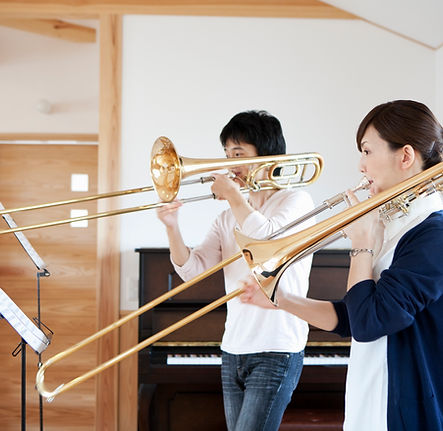
Trombone
The trombone is a prominent brass instrument distinguished by its unique telescoping slide mechanism, which allows for a fully chromatic range and smooth gliding between notes (glissandos). Originally called the sackbut in the 15th century, it was favored for its ability to mimic the human voice and was primarily used in religious settings before becoming a standard orchestral and jazz fixture. Playing requires deep diaphragmatic breathing and steady airflow, which significantly increases lung capacity and respiratory efficiency, often compared to that of athletes. It is particularly beneficial for managing conditions like asthma or COPD.

French Horn
The French horn—properly referred to simply as the horn by the International Horn Society—is a versatile brass instrument known for its distinctive circular shape and rich, mellow tone. Originally used as a hunting signal in the 17th century, it has evolved into a central orchestral instrument that bridges the gap between the brass and woodwind sections. Playing requires significant breath control and the use of full lung capacity, which can improve breathing patterns and efficiency, sometimes comparable to the lung efficiency of athletes.

Euphonium
The euphonium is a tenor-voiced brass instrument characterized by its large conical bore, which produces a rich, velvety, and mellow tone. Derived from the Greek word euphōnos, meaning "sweet-voiced," it is often referred to as the "cello of the brass world" due to its expressive and lyrical qualities. Invented in the 1840s, it typically features three or four piston valves and is a staple in concert bands, brass bands, and military ensembles. Playing the euphonium acts as a continuous form of respiratory muscle training, requiring significant lung capacity and diaphragmatic control. This intensive breath management can improve overall lung efficiency, potentially rivaling the respiratory fitness of athletes.

Tuba
The tuba is the largest and lowest-pitched member of the brass family, characterized by its wide conical bore and deep, resonant tone. Invented in 1835 in Prussia, it was designed to provide a stable bass foundation for orchestras and military bands, replacing less reliable instruments like the serpent. Modern tubas come in various sizes (from 3/4 to 6/4) and shapes, including the concert tuba for sitting and the circular sousaphone designed for marching. Playing the tuba is a continuous form of respiratory muscle training. It requires significant lung capacity and diaphragmatic control, which can improve blood oxygen levels, lower blood pressure, and strengthen core muscles.

Double Bass
The double bass, also known as the contrabass or upright bass, is the largest and lowest-pitched member of the orchestral string family. Standing approximately six feet tall, it typically features four strings tuned in fourths (E-A-D-G), one octave lower than the cello. It is unique among orchestral strings for its sloped "shoulders," a trait likely inherited from its ancestor, the violone. Highly versatile, the double bass provides the foundational rhythmic and harmonic "backbone" for diverse genres, including classical, jazz, bluegrass, and rockabilly. Bassists are consistently in high demand because they are essential to many ensembles but fewer people choose to play them. This often leads to more performance, socialization, and "gigging" opportunities compared to more common instruments.
Singing Courses

Music Exploration: Age: 3 - 4 years


Music exploration for 3- to 4-year-olds focuses on active engagement and playful discovery rather than formal mastery. At this stage, children are in a "pre-operational" developmental phase where they learn best through symbolic play and moving their whole bodies to rhythm.

Singing: Age: 5 - 6 years
A singing program for 5- to 6-year-olds (typically Kindergarten and Grade 1) transitions from simple musical play to building a foundation for musical literacy and vocal control. At this stage, children begin to distinguish between their speaking and singing voices and start to develop the ability to match pitch and maintain a steady beat.
-
Vocal Exploration: Activities that encourage children to explore the "four voices" (speak, sing, whisper, shout) and experiment with high and low registers.
-
Pitch Matching and Solfège: Introduction to basic melodic intervals using hand signs or solfège syllables (e.g., So-Mi or Do-Re-Mi) to help internalize pitch.
-
Rhythmic Accuracy: Integrating movement and simple instruments to teach the difference between the steady beat and the rhythm of the lyrics.
-
Group Performance: Programs often emphasize choir-like settings rather than private lessons, as collective singing fosters a sense of community and reduces performance anxiety.
-
Memory and Lyrics: Learning complex rhymes and story-based songs to improve auditory memory and language sequencing.

Singing: Age 7 - 8 years
For 7- to 8-year-olds, singing programs move beyond simple nursery rhymes toward developing technical vocal skill, musical independence, and collaborative performance. At this age, children’s vocal anatomy is maturing, making it a critical window for establishing healthy vocal habits without strain.
Core Program Components for 7–8 Year Olds
-
Vocal Technique: Introduction to proper posture, diaphragmatic breathing, and basic vocal warm-ups like humming and scales to expand their natural range safely.
-
Part-Singing and Harmony: Children begin learning to hold their own melodic line while others sing a different part (rounds or simple harmonies), which develops advanced listening and "aural discrimination".
-
Musical Literacy: Instruction often includes reading basic sheet music, understanding rhythmic notation, and recognizing musical symbols.
-
Ensemble and Choir Work: Focus shifts toward singing in a "team," where children learn to blend their voices and follow a conductor's dynamic cues.

Singing: Age: 9 - 10 years
For 9- to 10-year-olds, singing programs emphasize musical independence, advanced vocal health, and the transition toward professional-level foundational skills. At this age, children's voices become more distinguishable by gender as their vocal anatomy matures, and they gain the physical capacity for more rigorous breath control and lung function.
Core Program Components (2026)
-
Vocal Technique: Introduction to formal exercises for agility, such as alankars in Indian classical music or specialized riffs and runs in Western pop. Students learn to support sound from the diaphragm to increase power and reduce vocal fold strain.
-
Advanced Sight-Singing: Curricula often include reading complex rhythmic patterns and sight-singing in various keys, preparing students for intermediate-level choral or solo work.
-
Repertoire and Analysis: Programs encourage students to analyze the structure and "mood" of songs, fostering a deeper intellectual engagement with musical phrasing and tone coloring.
-
Performance Training: Focus is placed on stage presence, healthy posture, and overcoming performance anxiety through regular recitals or community events.

Singing: Age: 11 - 12 years
For 11- to 12-year-olds, singing programs bridge the gap between childhood vocal play and more mature, technical training, specifically addressing the early stages of puberty and vocal change. At this transitional age, curricula focus on building long-term vocal health and refined musicianship.
Core Program Components (2026)
-
Vocal Health and Puberty Management: Instruction at this level provides crucial support as the larynx begins to grow larger and thicker. Students are taught to manage "voice cracks" and breathiness through proper diaphragmatic support and by avoiding strain on maturing vocal folds.
-
Aural and Theoretical Foundations: Programs emphasize advanced ear training and music literacy. Students learn to read complex musical notation and understand sophisticated concepts like crescendo and intricate rhythmic patterns.
-
Ensemble and Collaborative Skills: Choral singing remains a central activity, teaching preteens how to work as a team and adjust their individual voices to achieve a unified sound.
-
Safe Individual Instruction: While group settings are common for building community, some experts suggest that 11–12 is an appropriate time to begin solo voice lessons to address the highly personal nature of a changing voice in a safe environment.

Singing: Age: 13 - 14 years
For 13- to 14-year-olds, singing programs become increasingly specialized, focusing on navigating dramatic vocal transitions caused by puberty while fostering a sense of identity and emotional outlet. At this stage, formal vocal training is highly beneficial as adolescents have the mental maturity and discipline to study deeper technical concepts.
Core Program Components (2026)
-
Vocal Change Management: Programs specifically support males experiencing laryngeal growth (often a 60% expansion) and significant pitch drops. Training focuses on managing "voice cracks" and transitioning safely between chest and head voice.
-
Safe Range Expansion: For both genders, training helps gradually extend the vocal range and develop a richer, more adult-like resonance without straining maturing vocal folds.
-
Advanced Musicality: Instruction includes complex harmonies, sight-reading intermediate scores, and understanding musical structures like phrasing and tone coloring.
-
Performance and Interpretation: Teens are encouraged to interpret lyrics creatively to express character and narrative, a skill central to musical theater and advanced solo work.